Why VOIP Quotes Are So Hard to Compare
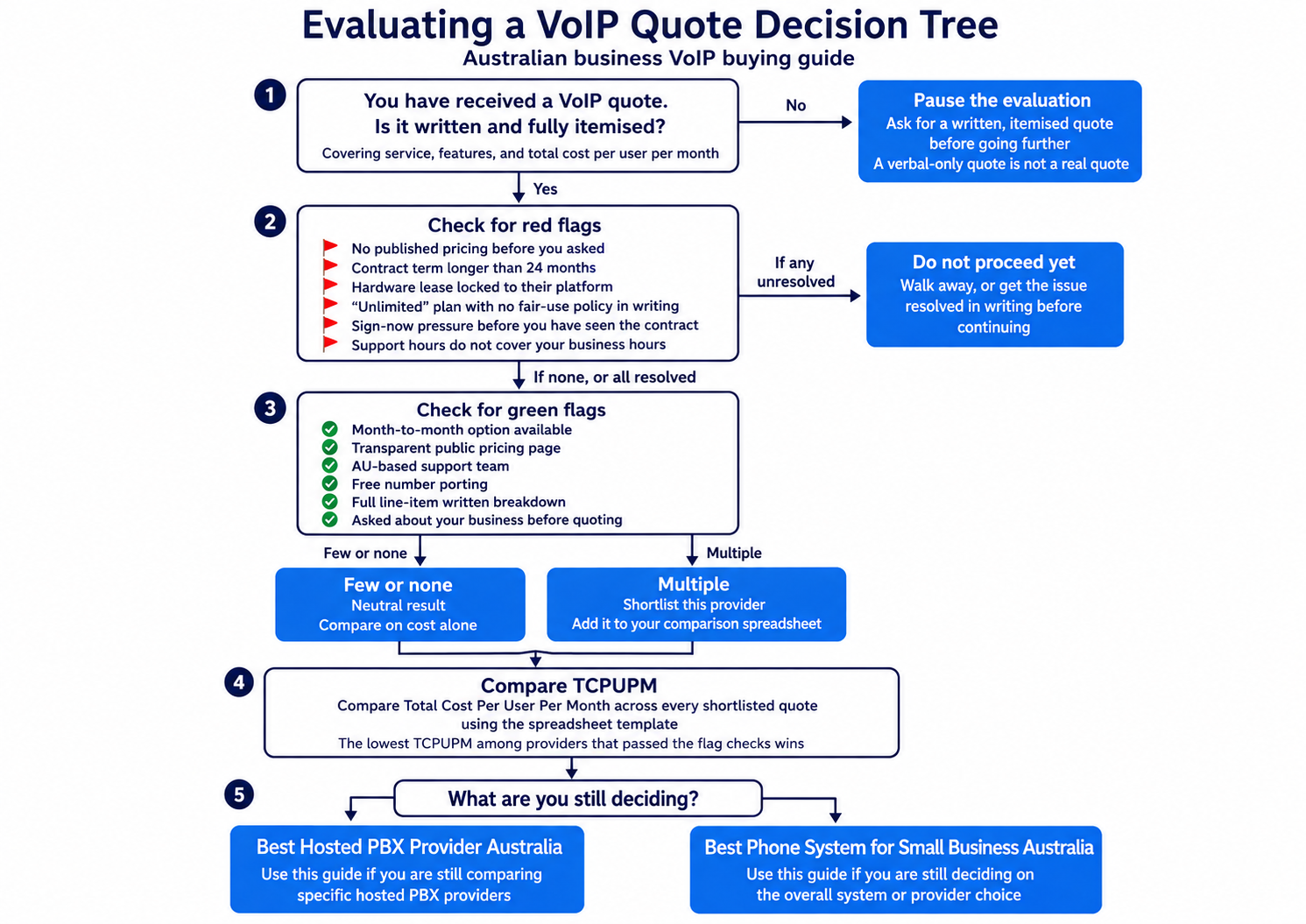
If you have gotten three VOIP quotes and cannot tell which is actually cheaper, that is by design. Providers use different bundling strategies, and quote formats are not uniform; however, telcos must also provide a Critical Information Summary setting out key inclusions, exclusions, fees, charges and contract terms. Each provider makes a commercial decision about what to lead with, what to bury in footnotes, and what to omit entirely.The four main reasons quotes are hard to compare: first, per-user versus per-line pricing. Some providers charge per user (each person who might pick up a phone). Others charge per concurrent call line (the number of calls your business can handle at once). For a business with 5 staff but only 2 calls at peak, these models produce very different numbers. Second, included versus add-on features. One provider quotes $25/user/month with call recording, number porting, and a 1300 number included. Another quotes $18/user/month but each of those items is an add-on. The cheaper headline price is often more expensive all-in. Third, call charges are structured inconsistently. Some providers bundle unlimited local and national calls. Others have unlimited local only, with national calls billed per minute. Others have a call credit included up to a certain dollar value. Fourth, hardware and setup costs. Some providers include hardware in the monthly fee via a rental model. Others quote hardware separately as an upfront cost. Neither is inherently better, but comparing a quote that includes hardware rental against one that does not is an apples-to-oranges exercise.The only reliable way to compare is to strip every quote back to a single number: total cost per user per month, including everything. This takes extra work, , but it is the only method that produces a meaningful comparison.The Apples-to-Apples Comparison Framework
The comparison framework works in three layers: service first, features second, price third. Most buyers do it in reverse (price first, then features, then worry about service). That order produces the wrong result because cheap pricing with poor support and SLA guarantees will cost far more in lost calls and business disruption than any price difference.Layer 1: Compare the Service
Before price matters, answer these questions for each provider: Is the support team AU-based or offshore? Can you speak to a human during business hours without waiting 45 minutes? What is the SLA for fault resolution, is it hours or business days? What happens if your phone system goes down at 9am on a Monday? Does the provider offer onboarding assistance or do you configure everything yourself? What is the porting process, do they handle it end to end, or do you have to coordinate with your current provider yourself? These are not small operational details. For a 5-person business that runs entirely on inbound calls, a 4-hour phone outage on a business day is a serious commercial problem. A provider with cheaper monthly fees but a 48-hour fault resolution SLA and offshore support may be a worse financial decision than a more expensive provider with local AU support and a 4-hour SLA.Layer 2: Compare the Features
Once you are satisfied with the service layer, compare features against your actual requirements, not a wish list. For most Australian small businesses, the core feature set is: inbound and outbound calling on a geographic number, voicemail to email, call hold and transfer, basic IVR or auto-attendant, and ring groups. List these requirements, then mark for each provider whether the feature is included in the quoted price, available as a paid add-on, or not available at all. Features that look standard are frequently add-ons. Call recording storage, advanced IVR menus, call analytics, and CRM integrations are common examples.Layer 3: Calculate Total Cost Per User Per Month
The final step is to calculate a single comparable number: total cost per user per month (TCPUPM), including every fee. The formula is: (monthly plan fee + call charges estimate + number fees + add-on features + hardware amortised or rental + setup fee amortised over contract term) divided by number of users. This produces a number you can compare directly across providers regardless of how they structured their quote. An estimate of call charges requires knowing your approximate call volumes. If you have a current phone bill, use actual minutes. If you are a new business, use an estimate based on expected call frequency and call duration.What to Include in Your Total Cost Calculation
A quote may exclude optional, usage-based or provider-specific costs, so check it against the Critical Information Summary and contract before calculating total cost. Before you can calculate TCPUPM accurately, you need to ask each provider about all of these items:| What to Ask | Typically Included? | |
|---|---|---|
| Monthly plan fee | Per user or per line? What is included? | Yes, always quoted |
| Local call charges | Unlimited or per minute? Fair use cap? | Often included |
| National call charges | Same plan as local or separate rate? | Sometimes included |
| Mobile call charges | Per minute rate to AU mobiles? | Rarely included |
| International call charges | Per minute rate to key destinations? | Never included |
| Number rental fee | Is a geographic number included or extra? | Often included, confirm |
| 1300/1800 inbound charges | Per minute rate when customers call your 1300? | Never included, billed separately |
| Caller ID (CID) fee | Is outbound CID display included or a monthly fee? | Sometimes extra |
| Number porting fee | What does it cost to bring your existing number across? | Usually a one-off, often omitted from quotes |
| Hardware (desk phones) | Buy outright, rent, or bring your own? | Never included unless explicitly stated |
| Setup and activation fee | One-off fee for account setup and provisioning? | Often omitted from initial quote |
| Call recording storage | Is storage included or pay per GB/month? | Rarely included beyond a small allocation |
| After-hours routing changes | Fee to modify IVR or routing rules? | Sometimes, ask before signing |
| Contract exit fee | What does it cost to leave before minimum term ends? | Always ask, never volunteered |
| Number cancellation fee | What happens to your numbers if you cancel? | Ask explicitly |
| Regulatory/carrier fees | Any line access or regulatory fees added to invoice? | Sometimes added at invoice, not always quoted |
The Hidden Cost Checklist (15+ Items)
These are the costs most commonly missing from initial VOIP quotes in Australia. Work through this list with every provider before calculating your TCPUPM.1. Caller ID display fee. Some providers charge an additional monthly fee to display your business number as the outbound caller ID. Ask: is outbound CID included in the plan or billed separately per user?2. Number porting fee. If you want to keep your existing phone number when switching providers, the new provider needs to initiate a number port. Porting fees vary by provider, number type and port complexity; complex geographic-number ranges and 13/1300/1800 ports can cost more than $50. It is rarely mentioned in initial quotes. See our number porting guide for Australia for a full explanation of the process and timeline.3. 1300 number inbound charges. If you use a 1300 number, you pay a per-minute or per-call charge for each inbound call that is forwarded to your VoIP system. This is separate from the 1300 number rental fee and separate from your phone system plan charges. For businesses with high inbound call volume, this can be a significant monthly cost. See our 1300 number guide for detailed cost breakdown.4. International call rates. Even if you only make international calls occasionally, ask for the per-minute rate to your key destinations. Rates vary enormously between providers, some include generous international bundles, others bill at premium per-minute rates. If you make even 20 minutes of international calls per month, this can swing the comparison significantly.5. After-hours routing configuration fees. Some providers charge a per-change fee or minimum service fee to modify your call routing, for example, changing your after-hours voicemail greeting, adding a new ring group, or adjusting IVR options. Others allow self-service changes via a portal at no charge. Ask how routing changes are handled and whether there is a cost.6. Call recording storage fees. Call-recording availability, retention limits and storage charges vary by provider and plan; check the applicable service schedule and Critical Information Summary. If call recording is important for compliance, training, or dispute resolution, ask for the storage policy and any overage costs.7. Hardware rental versus purchase. If the provider is including desk phones in their quote, confirm whether it is a purchase or a rental. Rental or supplied-handset arrangements vary: some devices must be returned, while ownership may pass under other contracts. Reuse with another provider depends on the handset, provisioning and receiving provider's compatibility rules. If you cancel the plan, you return the hardware. Purchase gives you ownership but requires upfront capital. Neither is inherently better, but they have very different financial implications.8. Contract exit fees. Fixed-term contracts may include early termination charges, with the calculation set out in the applicable Critical Information Summary or contract. This is rarely volunteered. Ask directly: if I need to cancel at month 6 of a 24-month contract, what do I pay? Some providers charge the remaining monthly fees in full. Others charge a flat early termination fee. Others waive exit fees under certain circumstances (e.g. provider fault, service failure). Know this before you sign.9. Number cancellation fees. If you cancel your service and do not port your number to a new provider before cancellation, you may lose the number permanently. Some providers charge a fee to hold a number in reserve during a port. Ask what happens to your numbers if you cancel and whether there is a window to port them out.10. Price rise clauses. Australian telecommunications contracts often include a clause allowing the provider to increase prices by CPI (Consumer Price Index) or a fixed percentage annually without triggering a right to exit. Check the contract terms for any automatic price rise provisions and whether a price rise gives you an exit right.11. Mobile call rate to AU mobiles. Australian mobile-call pricing varies by plan and may be included or usage-rated, so compare it separately where your team makes substantial mobile calls. If your team makes a significant volume of calls to Australian mobiles, this is an important line item to compare.12. Fair use caps on 'unlimited' plans. Plans described as unlimited may still have acceptable-use or fair-use terms, so check the written policy and the consequences of unreasonable use. Ask for the fair use threshold, commonly expressed as a monthly minutes cap or a daily minutes cap per user. Exceeding fair use may trigger overage charges or account throttling.13. Setup and activation fee. Some providers charge a setup or activation fee, while others waive or do not charge it; confirm the amount for the specific plan. This is sometimes waived on promotional terms, but it is a real cost to include in your comparison. Amortise it over the expected contract term to get a per-month equivalent.14. Softphone or app fees. If your team needs to take and make calls on a mobile app or desktop softphone as well as a desk phone, check whether the softphone/app is included or an additional per-user fee.15. Regulatory and carrier fees. Some providers add a line access fee, regulatory recovery fee, or carrier cost contribution to invoices. Check the quoted price against the Critical Information Summary and contract, which should disclose the applicable fees and charges. Ask whether the quoted price is the full invoice price or whether any fees are added.Contract Terms to Check Before Signing
The contract terms that most often create problems for Australian small businesses are: minimum term, auto-renewal clauses, exit fees, price rise provisions, and SLA guarantees. Read each of these sections specifically, do not skim.Minimum term. Most business phone companies offer both month-to-month and fixed-term contracts. Fixed-term contracts (12 or 24 months) typically come with lower monthly pricing. Pricing differences vary: a fixed term may reduce monthly fees, setup charges or hardware costs, but some providers keep the same monthly service price. For most small businesses in the first year with a provider, month-to-month is worth the premium. Once you have confirmed the provider works for your business, switching to a fixed term makes economic sense.Auto-renewal. Some contracts contain renewal or notice provisions, while others continue month-to-month after the minimum term; check what happens at expiry and whether notice is required. If you miss that window, you are locked in for another full term. Calendar the notice window the day you sign.Exit fees. As noted in the hidden cost checklist, exit fees vary significantly. The worst-case structure is the remaining-months model: if you have 12 months left on a $100/month plan, you pay $1,200 to exit. Get the exact exit fee calculation method in writing before signing, not as a verbal assurance from the sales team.Price rise clauses. In a qualifying standard-form consumer or small-business contract, a unilateral price-variation term without a balancing penalty-free exit right may be unfair under the Australian Consumer Law; only a court can finally determine whether a term is unfair. In practice, many telco contracts do include CPI-linked price rises. The safe position is to ask whether any price rise, regardless of size, gives you an exit right at no cost. Some providers explicitly offer this; others do not.SLA guarantees. The service level agreement defines what the provider promises to do when something goes wrong and what remedies you receive if they fail. Relevant elements: response time for fault acknowledgement, resolution time for different fault severity levels, uptime guarantee (commonly 99.9%, calculate what that means in minutes of downtime per year before accepting it), and what compensation applies if the SLA is breached. A provider with 99.9% uptime guaranteed is promising up to 8.7 hours of downtime per year. If your business runs on phone calls, ask whether that is acceptable.Red Flags in VOIP Quotes
These are signals that a provider may not be the right choice, or that a contract deserves extra scrutiny before signing.No pricing on the website. A call-for-quote model makes direct price comparison harder, but the absence of published pricing does not by itself establish that quotes are inflated. Transparent pricing is a green flag; opaque pricing is a red flag. It does not mean the provider is bad, but it does mean you are negotiating without a reference point.Minimum terms longer than 24 months. VOIP technology and pricing change quickly. A 36-month or 48-month contract locks you into pricing and features that may be significantly below market within 12 months. Unless there is a compelling commercial reason, do not sign more than a 24-month term for VOIP services.Hardware lease lock-in. If the provider is supplying hardware via a lease or rental arrangement and that hardware is locked to their platform (i.e. cannot be factory reset and used with another provider), you are in a locked ecosystem. Switching providers requires returning hardware and re-purchasing, which adds a real switching cost. Prefer hardware you own outright, or hardware that is vendor-neutral and can be re-configured if you switch.'Unlimited' with no fair use documentation. An unlimited plan may still be subject to acceptable-use or fair-use terms; ask for the applicable policy and check whether it contains quantitative limits or restricted usage patterns. If a provider cannot or will not tell you the fair use threshold in writing, that is a red flag. The policy may be set at a level that is fine for your call volume, but you need to know what it is.Quote delivered verbally with no written breakdown. Any quote you cannot hold the provider to in writing is not a real quote. Pricing, inclusions, add-ons, contract terms, and exit fees must all be in writing before you commit to anything.Pressure to sign before seeing contract documentation. Legitimate providers will always give you time to read the contract before signing. If a salesperson is applying time pressure or discounting language to push you to sign before you have read the terms, walk away.Support hours that do not match your business hours. If your business operates outside standard business hours and the provider's support is only available 9am-5pm Monday to Friday, you are exposed outside those hours. Ask specifically: if I have a phone outage at 8am Saturday, what happens?Green Flags in VOIP Quotes
These are positive signals that indicate a provider is worth shortlisting and engaging seriously.Month-to-month option available. A provider who offers month-to-month at a modest premium over fixed term is not afraid of customers leaving. It signals confidence in their service quality. Even if you ultimately sign a fixed term for the price benefit, the availability of month-to-month tells you something about the provider.Transparent pricing page. Published pricing is a trust signal. It means the provider is competing on merit, not on information asymmetry.AU-based support team. For Australian SMBs, AU-based support is meaningful. It is not only a time zone issue, it is about whether the support person understands NBN connection types, AU porting timelines, and the specific ways Australian businesses operate. Offshore scripted support is appropriate for consumer ISPs. For business VOIP with active call routing, AU-based support is worth paying for.Free number porting. Providers who waive the porting fee are signalling that they want you on the platform, not just your credit card. It is a relatively low-cost gesture from the provider's perspective but reflects a customer-acquisition philosophy that tends to produce better long-term service behaviour.Written quote with full line-item breakdown. A provider who gives you a detailed written quote with every fee itemised is operating transparently. This is also the only type of quote you should be comparing, if the quote does not show the breakdown, ask for it before proceeding.Asks about your business before quoting. A provider who asks how your business operates, call volumes, team structure, current setup, key requirements, before quoting is taking a consultative approach. This is more likely to produce a quote that actually fits your needs, and it is a signal of how the support relationship will work after you sign.10 Questions to Ask Every Provider
Use this checklist with every provider you are seriously evaluating. Ask all 10 questions and get answers in writing (via email follow-up if not in the initial quote document).1. What is the total monthly cost per user including all fees, plan, call charges at my estimated volume, number fees, and any add-ons I need? Can you give me a written itemised breakdown?2. Is there a fair use policy on calls described as 'unlimited'? What is the threshold, and what happens if I exceed it?3. What is the one-off cost to port my existing number(s) to your platform? How long does it take, and is there any downtime during porting?4. What is the minimum contract term? Is month-to-month available? What is the exit fee if I need to cancel before the minimum term ends?5. Does the contract include any automatic price rise provisions? If prices increase, do I have a right to exit without penalty?6. Where is your support team based? What are your support hours? What is your fault resolution SLA for a critical outage (phones completely down)?7. What is the uptime SLA? What compensation applies if you breach it?8. Are desk phones included in the quote? If so, are they purchased outright or rented? If rented, can they be used with another provider if I switch?9. What features are included in the base plan versus available as paid add-ons? Specifically: call recording, IVR, ring groups, voicemail to email, softphone app, CRM integration.10. If I need to cancel my service: how much notice do I need to give? What happens to my phone numbers, do I have time to port them out before cancellation takes effect?Comparison Spreadsheet Template
Build a simple spreadsheet with one column per provider and one row per comparison item. This forces you to fill in every cell, blanks reveal missing information that you need to follow up on. The columns that matter most:| Provider A | Provider B | Provider C | |
|---|---|---|---|
| Base plan price (per user/month AUD) | |||
| Included calls (local/national/mobile) | |||
| Estimated monthly call charges | |||
| Number rental fee (monthly) | |||
| 1300 inbound rate (per min) | |||
| Number porting fee (one-off) | |||
| Hardware cost (purchase or rental) | |||
| Setup / activation fee (one-off) | |||
| Contract term options | |||
| Exit fee | |||
| AU-based support (Y/N) | |||
| Support hours | |||
| Fault resolution SLA | |||
| Total estimated cost per user per month (TCPUPM) |
AU Reality: What Makes VOIP Comparisons Uniquely Complex in Australia
Australian businesses face some comparison challenges that are specific to the local market. Understanding these makes the evaluation process less frustrating.NBN connection quality affects call quality differently across providers. Not all business phone companies have the same approach to Quality of Service (QoS) configuration and codec selection on Australian NBN connections. Call quality can depend on access technology, equipment, broadband plan, traffic class and how the provider designs its network; ask what QoS or NBN traffic-class options are offered. Ask whether the provider has specific NBN optimisation, and whether they have an NBN compatibility checker. Our NBN VOIP compatibility guide explains what to look for in detail.PSTN copper shutdown. Most legacy fixed-line phone services in NBN fixed-line rollout areas have migrated, but Australia did not complete a nationwide PSTN copper shutdown in 2025; copper and other legacy services remain in some areas and service categories. Australian phone services use several access networks and technologies, including NBN fibre, HFC, FTTN copper, fixed wireless and satellite, retained copper services, mobile networks and non-NBN networks. Many Australian business phone services are now VoIP, but copper landlines and other non-VoIP service types remain available in some areas and service categories. When comparing providers, you are comparing VOIP-over-NBN options. Traditional copper landlines are no longer the dominant fixed-phone option, but they still exist in some locations and service categories.Number porting timelines in Australia. Under ACMA's Local Number Portability (LNP) framework, porting geographic numbers generally takes 8-15 business days (80% within 8 business days, 98% within 15). Complex ports (multiple numbers, enterprise connections) can take longer. During the porting window, your existing number remains active with your current provider. There is usually a brief service window (minutes to a few hours) when the port completes, during which inbound calls may not reach you. Ask your new provider how they manage this transition and what the contingency is.000 emergency calling limitations. Standard VOIP services have specific limitations around emergency calling. A VoIP service using a public number must have customer and service-address information supplied to the IPND, but the caller may be at a different location, so the 000 operator may need to confirm the caller's actual town, state and address. Ask each provider for their 000 policy: can you call 000 from the service, what location information is provided to emergency services, and is there a fallback arrangement? Under Australian telecommunications regulations, providers are required to provide 000 access, but the quality and reliability of location data varies.Power outage vulnerability. VOIP phone systems require power to operate. If your NBN connection equipment (NBN termination device and router) loses power, your phones go down. Traditional directly connected copper phones could operate from network power, while most NBN-delivered VoIP services will not work during a power outage unless all required equipment has suitable backup power. For businesses in areas with unreliable power or bushfire risk, a UPS (uninterruptible power supply) on the networking equipment is worth including in the total cost comparison. Ask each provider whether they recommend a UPS and what the specifications are for your setup.The Big ISP Bundle Versus the Specialist Provider
One comparison you may be running is between a bundle from a major ISP (Telstra, Optus, TPG, Aussie Broadband) and a specialist business business phone company (Maxotel, net2phone, VoIPLine, Commander, etc.). These two categories are fundamentally different to compare.Some ISP bundles can be difficult to disaggregate, but major ISPs also publish standalone voice pricing and Critical Information Summaries for some business-phone products. Internet + phone in one invoice sounds simple, but it means you cannot see what you are paying for each service, you cannot easily move just the phone service if you find a better VOIP deal, and you are dependent on the ISP's support team for both services. Support capability varies by provider; compare support location, hours, escalation paths and demonstrated ability to configure and troubleshoot the specific phone system.Some specialist providers publish detailed itemised pricing, but transparency varies; compare each provider's written quote, Critical Information Summary and contract. You get a clear per-service invoice, you can change providers without touching your internet, and you deal with a team whose entire focus is VOIP. The support person you speak to has dealt with your specific setup type before. The trade-off is that you have two vendors to manage. For most small businesses, that trade-off is worth it.If you do want to compare a bundle against a specialist provider, extract the phone component from the bundle price by asking the ISP: what would my monthly cost be for internet only, without the phone component? The difference is the bundle's incremental price relative to that provider's internet-only offer; confirm that bundle discounts, internet-tier differences and other conditions do not distort it as a proxy for phone cost. Compare that against the specialist provider's all-in TCPUPM.What Most Businesses Get Wrong When Comparing VOIP Quotes
Mistake 1: Comparing headline prices without calculating total cost. The most common comparison error is picking the lowest monthly per-user price without accounting for call charges, number fees, add-ons, and setup costs. A provider quoting $15/user/month with everything as an add-on is often more expensive all-in than one quoting $28/user/month with more included. Always calculate TCPUPM before ranking.Mistake 2: Evaluating features before evaluating service. Comparing feature lists is easy because providers publish them. Evaluating support quality, SLA reliability, and porting competence requires asking questions the sales process is not designed to facilitate. Most buyers skip Layer 1 (service) and jump straight to Layer 2 (features) and Layer 3 (price). The result is a technically cheaper plan with a support experience that costs far more in business disruption.Mistake 3: Not asking about exit terms before signing. Fixed-term contracts may include early termination and renewal provisions, so check the applicable Critical Information Summary and contract before signing. Businesses that do not ask often discover them at the worst possible time: when they are trying to leave. Read the minimum term, exit fee, and auto-renewal sections of the contract specifically before signing anything.Your Next Steps
Use this checklist to structure your provider comparison from here:1. List your actual requirements. How many users need phones? What is your estimated monthly call volume (local, national, mobile, international)? Do you need a 1300 number? Do you need call recording? Do you have an existing number you want to port?2. Get written quotes from at least three providers. Use the 10 questions checklist above in every conversation. Ask for a written itemised quote, not a verbal quote or a brochure price.3. Build the comparison spreadsheet. Fill in the comparison table template above for each provider. Do not proceed until every cell is filled or the provider has confirmed an item does not apply.4. Work through the hidden cost checklist. For each provider, go through all 15 items. Add any additional costs to the relevant provider column in your spreadsheet.5. Calculate TCPUPM for each provider. Divide total monthly cost (including amortised one-off fees) by number of users.6. Score Layer 1 (service) for each provider. Based on the answers to your 10 questions: AU-based support (Y/N), support hours, fault resolution SLA, porting track record. Weight this heavily, a $5/user/month difference is meaningless against one bad outage with no resolution path.7. Read the contract terms for your shortlisted provider. Focus specifically on: minimum term, auto-renewal window, exit fee structure, price rise clause, and SLA guarantee. If anything is unclear, ask for a written explanation before signing.8. If you want a guided recommendation tailored to your business, use our Get a Recommendation form. Tell us your team size, requirements, and current setup and we will point you to the right provider for your situation. For an estimate of monthly costs before you start talking to providers, try our VOIP cost calculator.Once you have a shortlisted provider and are ready to evaluate them in more depth, see our best business phone company guide for a detailed breakdown of the major AU providers and what each one does best. For a deep dive on hardware to pair with your chosen provider, see our best SIP desk phone guide.Why are VOIP quotes in Australia so hard to compare?
Australian business phone companies use different bundling strategies, pricing models (per-user versus per-line), and inclusions, which makes headline prices misleading. One provider may quote a low monthly fee with most features as paid add-ons. Another may quote a higher fee with more included. Without calculating total cost per user per month including all fees, you cannot determine which is actually cheaper. Providers are aware of this and generally do not volunteer the comparison-simplifying information.
What is per-user versus per-line VOIP pricing?
Per-user pricing charges based on how many people need access to the phone system. Per-line pricing charges based on how many simultaneous calls your business needs to handle. For a 5-person team that rarely has more than 2 calls active at once, per-line pricing may be cheaper. For a team where most staff make and receive calls throughout the day, per-user pricing may be more appropriate. When comparing quotes, confirm which model each provider uses and calculate the real monthly cost for your specific team size and call pattern.
What should I do if I want to keep my existing phone number when switching business phone companies?
Number porting allows you to transfer your existing geographic number (02, 03, 07, 08) or other number to a new provider. The new provider initiates the port request. In Australia, porting geographic numbers generally takes 8-15 business days under ACMA's Local Number Portability Code. Your existing number remains active until the port completes. Ask your new provider about their porting process, any fees, and how they manage the transition window. Do not cancel your existing service before the port is complete, cancellation terminates your right to port the number.
What does 'unlimited calls' actually mean on an Australian phone system plan?
An unlimited phone plan may still have acceptable-use or fair-use terms, but these do not always impose a numerical cap; they may instead restrict particular usage patterns or unreasonable use. The threshold is commonly expressed as a monthly minutes limit (e.g. 3,000 minutes per user per month) or a daily limit. Exceeding the fair use threshold may result in overage charges, call throttling, or account review. Before relying on an 'unlimited' plan, ask the provider for the fair use policy in writing and compare your estimated call volume against the threshold.
What exit fees should I expect on a VOIP contract in Australia?
Exit fee structures vary significantly between providers. Common models include: paying all remaining monthly fees for the contract term, a flat early termination fee (e.g. $150-$500), or a sliding scale that reduces as you approach the end of the minimum term. Some providers waive exit fees if the termination is due to service failure or relocation outside coverage. Always ask for the exit fee structure in writing before signing. Under Australian Consumer Law, unfair contract terms can be challenged, but it is far better to understand the terms before signing than to challenge them after.
Is it worth choosing a specialist business phone company over bundling phone with my internet provider?
For most Australian small businesses, yes. Specialist business phone companies offer transparent pricing, AU-based support focused entirely on business phone systems, and the ability to switch providers without changing your internet service. Major-ISP phone offerings vary: some publish detailed pricing and Critical Information Summaries, and support location and expertise should be checked provider by provider. The trade-off is managing two vendors instead of one, which is usually worth it for better service quality and commercial flexibility.
Can VOIP phones call 000 in Australia?
Australian carriage service providers supplying an emergency telephone service must provide 000 access, but not every product described as VoIP necessarily falls into that category; confirm the specific service's 000 capability and policy. Public-number VoIP services must have customer and service-address information supplied to the IPND, but because the user may be somewhere else, that stored address may not identify the caller's actual location. Providers are required to supply the registered address for the service when 000 is called, but this may be an office address rather than the precise location of the call. If your team works across multiple locations or remotely, ask your provider specifically how 000 is handled and what location data is transmitted.
Try our free tools
Get specific numbers for your business with our VOIP Cost Calculator and Phone System Sizing Wizard.
Related reading:
Want a Recommendation Matched to Your Business?
Get a Recommendation